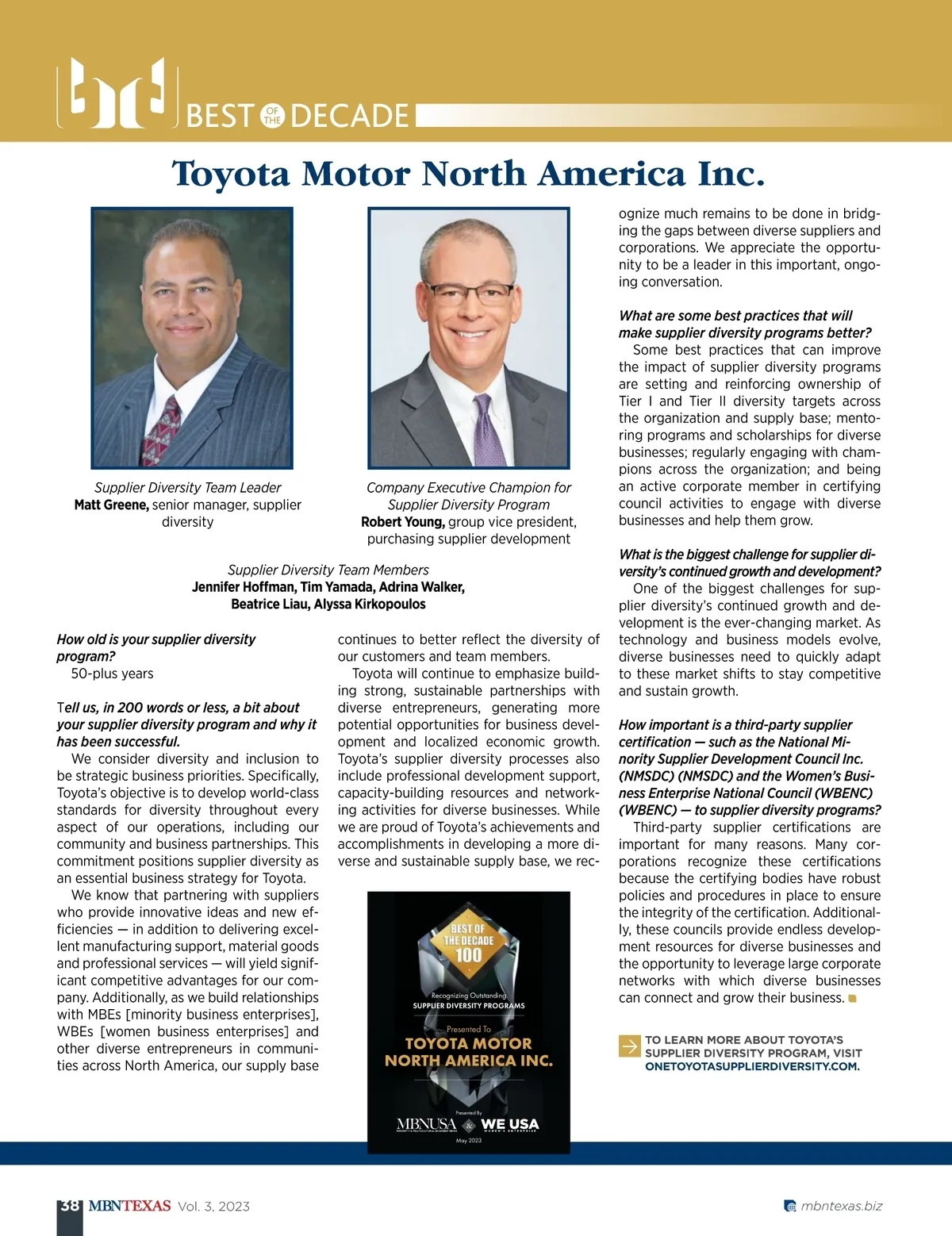
Toyota Motor North America Inc. ognize much remains to be done in bridg-ing the gaps between diverse suppliers and corporations. We appreciate the opportu-nity to be a leader in this important, ongo-ing conversation. What are some best practices that will make supplier diversity programs better? Some best practices that can improve the impact of supplier diversity programs are setting and reinforcing ownership of Tier I and Tier II diversity targets across the organization and supply base; mento-ring programs and scholarships for diverse businesses; regularly engaging with cham-pions across the organization; and being an active corporate member in certifying council activities to engage with diverse businesses and help them grow. What is the biggest challenge for supplier di-versity’s continued growth and development? One of the biggest challenges for sup-plier diversity’s continued growth and de-velopment is the ever-changing market. As technology and business models evolve, diverse businesses need to quickly adapt to these market shifts to stay competitive and sustain growth. How important is a third-party supplier certification — such as the National Mi-nority Supplier Development Council Inc. (NMSDC) (NMSDC) and the Women’s Busi-ness Enterprise National Council (WBENC) (WBENC) — to supplier diversity programs? Third-party supplier certifications are important for many reasons. Many cor-porations recognize these certifications because the certifying bodies have robust policies and procedures in place to ensure the integrity of the certification. Additional-ly, these councils provide endless develop-ment resources for diverse businesses and the opportunity to leverage large corporate networks with which diverse businesses can connect and grow their business. Supplier Diversity Team Leader Matt Greene, senior manager, supplier diversity Company Executive Champion for Supplier Diversity Program robert young, group vice president, purchasing supplier development Supplier Diversity Team Members Jennifer Hoffman, tim yamada, adrina walker, Beatrice liau, alyssa kirkopoulos How old is your supplier diversity program? 50-plus years T ell us, in 200 words or less, a bit about your supplier diversity program and why it has been successful. We consider diversity and inclusion to be strategic business priorities. Specifically, Toyota’s objective is to develop world-class standards for diversity throughout every aspect of our operations, including our community and business partnerships. This commitment positions supplier diversity as an essential business strategy for Toyota. We know that partnering with suppliers who provide innovative ideas and new ef-ficiencies — in addition to delivering excel-lent manufacturing support, material goods and professional services — will yield signif-icant competitive advantages for our com-pany. Additionally, as we build relationships with MBEs [minority business enterprises], WBEs [women business enterprises] and other diverse entrepreneurs in communi-ties across North America, our supply base continues to better reflect the diversity of our customers and team members. Toyota will continue to emphasize build-ing strong, sustainable partnerships with diverse entrepreneurs, generating more potential opportunities for business devel-opment and localized economic growth. Toyota’s supplier diversity processes also include professional development support, capacity-building resources and network-ing activities for diverse businesses. While we are proud of Toyota’s achievements and accomplishments in developing a more di-verse and sustainable supply base, we rec-Recognizing Outstanding SUPPLIER DIVERSITY PROGRAMS TOYOTA MOTOR NORTH AMERICA INC. Presented By Presented To TO LEARN MORE ABOuT TOyOTA’S SuPPLIER DIVERSITy PROGRAM, VISIT ONETOyOTASuPPLIERDIVERSITy.COM. MBNUSA MINORITY & MULTICULTURAL BUSINESS NEWS & WE USA WOMEN’S ENTERPRISE May 2023 38 Vol. 3, 2023 mbntexas.biz
MBN Texas MBN Texas v3 2023: Page 38